I built another app. This time I was sitting on the stands of the ice skating arena while my daughter practiced in one of the public sessions. This one was for personal use, though I build just as many things for work.
I have created a lot of apps over the last year, some for myself and plenty for work, and build not buy has been my motto. I mean the general purpose tools with one specific use case for me. No, I have not cancelled my Netflix account. In the last few months I built a PDF compressor, an app that reads a stock market chart and gives me the interpretation in the format I want, and one for sentiment analysis. There are also loads of small interactive web pages I put together to make a point in the room. One walks me through getting powers of attorney done. Another is a study app for my 5 year old that tells me which topic to pick for a 20 minute session with her.
Not all of them worked. The sentiment analysis app was meant to pull real insight out of chat transcripts. It ran without a single error and the output was useless to me. I stopped using it. I will come back to why that matters.
The one from the ice arena counts the hours my daughter has skated since her blades were last sharpened. The thumb rule is a sharpening after every 20 hours. I had been keeping a record in Notes and was thinking about a custom automation in Shortcuts. But we are in the age of AI, so I started with what annoyed me about the process.
- I didn’t want to type the date every time and make mistakes. I wanted a calendar to pick from.
- I didn’t want to add up the hours on every entry.
- I wanted a record of every hour she has trained.
- I wanted a red banner inside the app when I get close to the threshold. No push notification, no SMS.
I also set some restrictions.
- Nothing hosted anywhere. It lives on my phone.
- No database. A JSON file in the Files app would do.
- No support. It is a personal application and I would not maintain it for anyone else.
I fed all of this to Claude and within a few minutes I had a working app. A local file that runs in my browser and writes to a JSON file in Files.
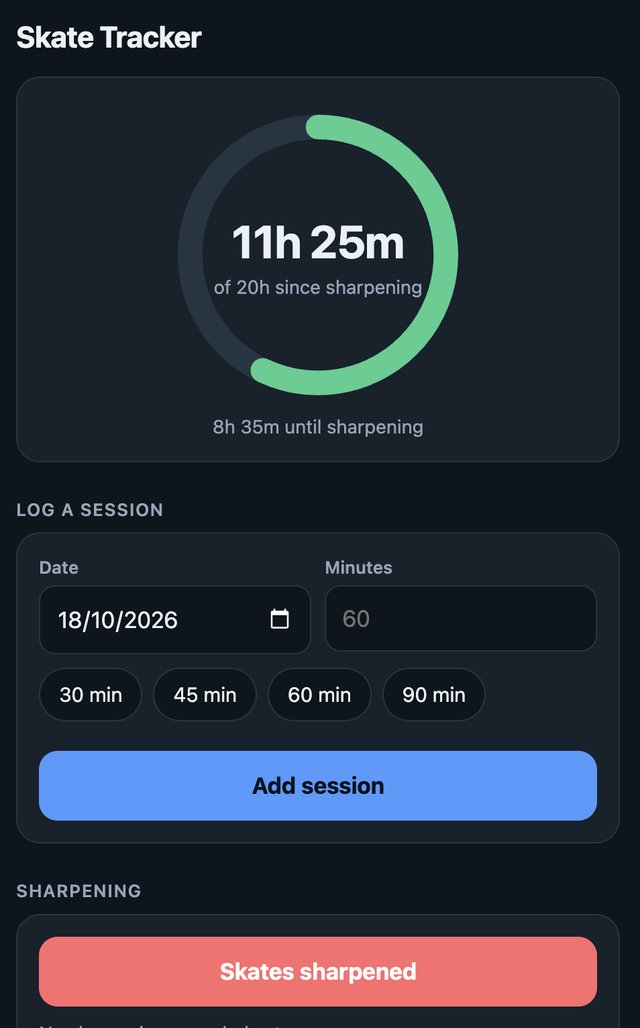
I was pleased with myself, and I had a line ready. I get the challenges with vibe coding. Scalability, governance and security are what my colleagues and I work through every day, and none of it matters for a small personal automation. An £18 Claude subscription is worth more than every mini subscription and small app purchase I would ever have needed.
I no longer say it that way, because it does not survive a second look.
Start with the £18. I was comparing it against purchases I was never going to make. Nobody was going to pay for a skate sharpening tracker. The real alternative was a note on my phone. What I replaced was a compromise, not a product.
The PDF compressor tells the same story. I needed at least 12 documents uploaded for an official application, with a maximum of 5 files and 1 MB per file. They didn’t mind if documents were merged into one file. Every compressor I tried failed me, even after compressing, recompressing and merging. So I built my own with Claude. It unpacks the file, reduces the resolution and compresses it. I called no APIs from other services. I used to tell this as a story about something that worked when everything else failed. I now think the better point is that these were official documents and no third party service ever saw them. I never planned that as a feature. It is the one I would defend.
Then there is the third restriction. I wrote that I don’t need support, and in the same breath I mentioned ideas for tracking my daughter’s progress. The moment I want to grow an app, I own it. Every iOS update and every change in how the browser handles files becomes mine to fix. The data sits in a JSON file that is only as safe as my backup habit.
The work tools taught me the same lesson, only faster. A page that makes a point in the room is disposable. The moment a colleague wants to use it tomorrow, someone has to own it, secure it and answer for what it says. I know this from my day job. I still had to relearn it from my own tools.
The sentiment app taught me something different. The code was never the problem. Claude wrote it in minutes, as it did everything else. The problem was that I did not know precisely what I wanted from a pile of chat transcripts. With the skate tracker I could list four annoyances and three restrictions, and the app followed. With the transcripts I had a vague hope that insight would appear. It did not. Building got cheap. Knowing what to ask of the data did not.
So does AI kill the small apps in the app store. The numbers point somewhere I did not expect. Sensor Tower counted 235,800 new App Store submissions in the first quarter of 2026, up 84% on the year before. That is a third party estimate, and the link to vibe coding is inference rather than something Apple has confirmed. Over the same period downloads reportedly grew by just 3% last year and 2% so far this year. More apps are being made and the appetite is flat. That is not a death. It is a crowd. Apple has also pulled and restricted vibe coding apps this year over its rules on software that changes after review. My apps never entered any of that. A local file writing JSON into Files does not compete for a download.
Here is what I took from it.
First, what dies is the small app you buy for a need only you have. What survives is anything that offers something I cannot generate in an afternoon. A network of other users. Data someone trusts. Hardware integration. Sync across devices. And a person who keeps it working when the platform changes underneath it.
Second, the scarce skill is no longer coding. It is specifying, and specifying means knowing the question before you ask it. Years of consulting taught me to write requirements, and I only understood that was the skill when I watched the skate tracker appear in minutes. The sentiment app showed the other side. Without a clear question, the fastest builder in the world hands you something that runs and tells you nothing.
I still believe in build not buy. I have just stopped treating it as a verdict on the app market. It is a verdict on how little distance is left between a clear need and working software. I still pay for Netflix. I will keep paying for what I cannot build, and for whoever keeps a tool working when the ground moves. Small apps will not disappear. The ones that sell a single feature will struggle. The ones that sell trust, upkeep and a network will not.
Sources for the App Store figures are The Information and TechSpot, both citing Sensor Tower.